





Delivering Accurate Structural, Crystallinity & Residual Stress Evaluation Across Industries
INTRODUCTION
In the pharmaceutical industry, data integrity is a fundamental requirement that supports product quality, regulatory compliance, and patient safety. Every decision related to drug development, testing, manufacturing, and release relies on the availability of accurate, complete, and reliable data. As pharmaceutical companies increasingly outsource critical activities to Contract Research Organizations (CROs), Contract Testing Laboratories (CTLs), and Contract Development and Manufacturing Organizations (CDMOs), maintaining data integrity has become more complex and strategically important.
While outsourcing offers advantages such as specialized expertise, scalability, and cost efficiency, it also introduces risks associated with reduced oversight, diverse quality systems, and varying levels of regulatory maturity. Regulatory agencies worldwide consistently emphasize that pharmaceutical manufacturers retain ultimate responsibility for data generated by external partners.
Understanding Data Integrity
Data integrity refers to the accuracy, consistency, completeness, and reliability of data throughout its lifecycle, from creation and processing to storage, retrieval, and archival. In the pharmaceutical environment, data integrity applies not only to laboratory results and manufacturing records but also to electronic records, metadata, audit trails, and supporting documentation.
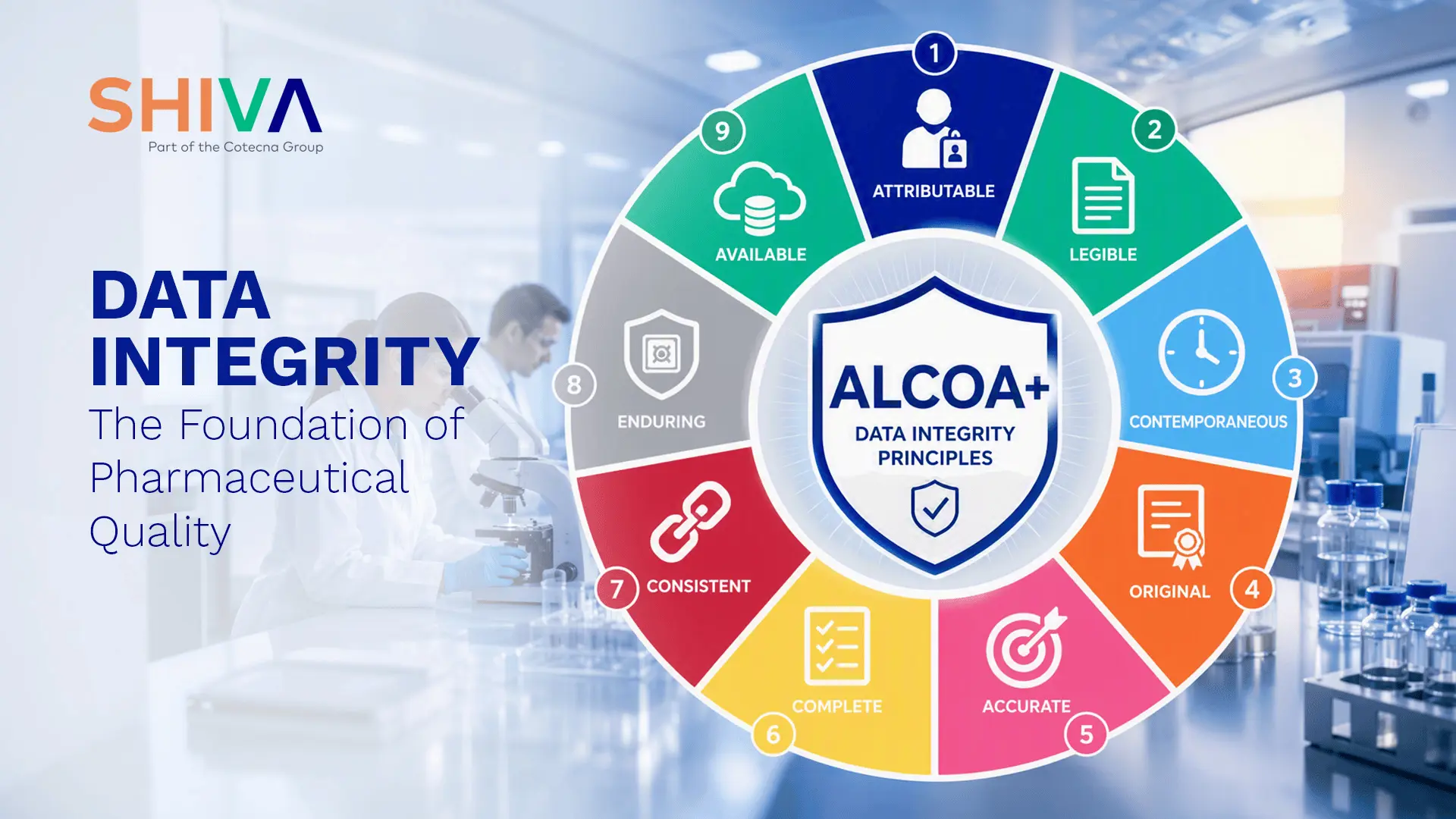
The pharmaceutical industry widely applies the ALCOA+ principles to ensure data integrity. ALCOA stands for Attributable, Legible, Contemporaneous, Original, and Accurate, while the “+” extends these requirements to include Complete, Consistent, Enduring, and Available data throughout its lifecycle:
Attributable: Records clearly identify who performed an activity and when.
Legible: Data remains readable and permanent.
Contemporaneous: Information is recorded at the time of activity.
Original: Original records or verified true copies are maintained.
Accurate: Data honestly reflects actual events.
Complete, Consistent, Enduring, and Available throughout the record lifecycle.
More recently, organizations have adopted the concept of ALCOA++, emphasizing additional attributes such as Traceability, Credibility, and Corroboration of data, particularly in highly digitalized and outsourced environments. Together, these principles ensure that data remains reliable, verifiable, and suitable for supporting product quality, regulatory compliance, and patient safety
These principles form the foundation of Good Manufacturing Practices (GMP) and are central to regulatory compliance worldwide.
Outsourcing and Emerging Data Integrity Risks
The growing reliance on outsourced partners has transformed pharmaceutical operations. External organizations now perform critical activities including analytical testing, method validation, stability studies, microbiological analysis, and clinical research. While these partnerships provide operational benefits, they also create additional challenges for maintaining data integrity.
Key risks include:
Limited visibility into third-party operations and data handling practices.
Data manipulation or falsification under schedule or commercial pressures.
Weak electronic system controls, including inadequate audit trails and shared user accounts.
Poor record-keeping practices, especially in paper-based systems.
Documentation inconsistencies and communication barriers in global operations.
These issues can compromise product quality, delay regulatory approvals, trigger warning letters or recalls, and potentially impact patient safety. Therefore, pharmaceutical companies must recognize that outsourcing activities does not transfer regulatory accountability.
Role of Contract Testing Laboratories (CTLs)
Contract Testing Laboratories play a critical role in supporting pharmaceutical manufacturers through analytical testing, method validation, stability studies, microbiological testing, and batch-release testing. As generators of critical quality data used for regulatory submissions and product disposition decisions, CTLs must maintain robust data integrity controls, validated systems, and strong quality management practices. Effective collaboration between pharmaceutical companies and CTLs helps ensure reliable data, regulatory compliance, and consistent product quality
Regulatory Expectations
Global regulatory authorities share a common expectation: data generated by outsourced partners must meet the same standards as data produced internally. Agencies such as the FDA, EMA, MHRA, WHO, Health Canada, and others require organizations to implement effective controls that ensure data remains trustworthy throughout its lifecycle.
Key expectations include:
Validation of computerized systems.
Secure audit trails and controlled user access.
Effective vendor qualification and risk assessment.
Continuous oversight of outsourced activities.
Access to raw data and supporting records.
Ongoing data integrity training and governance programs.
Regulatory enforcement actions have repeatedly demonstrated the consequences of inadequate oversight. Inspections have identified issues such as deleted analytical runs, disabled audit trails, undocumented data manipulation, poor backup practices, and unrestricted system access. These findings reinforce the need for strong governance and transparency across outsourced operations.
Best Practices for Maintaining Data Integrity
To minimize risk and maintain compliance, pharmaceutical manufacturers should implement a comprehensive oversight framework for all outsourced activities.
Vendor Qualification and Risk Assessment
Organizations should conduct thorough evaluations of potential service providers, including assessments of quality systems, inspection history, data integrity controls, and electronic records management capabilities. High-risk activities require enhanced oversight.
Strong Quality Agreements
Quality agreements should clearly define responsibilities related to data ownership, retention, audit rights, deviation management, raw data access, and compliance expectations. These agreements create accountability and establish governance requirements from the outset.
Regular Audits and Monitoring
Routine audits, performance reviews, and data assessments help identify potential weaknesses before they become regulatory concerns. Both scheduled and risk-based audits are essential.
Transparency and Data Access
Manufacturers should maintain access to raw data, audit trails, laboratory records, investigation reports, and electronic system logs. Transparency is critical for compliance and inspection readiness.
Training and Culture Development
Data integrity cannot be sustained through procedures alone. Continuous training, leadership commitment, and an organizational culture that promotes ethical behavior and transparency are equally important. Both internal teams and external partners should understand the importance of accurate and complete data recording.
Technology and Digital Controls
Validated electronic systems, role-based access controls, secure audit trails, and real-time monitoring tools enhance data reliability and traceability. Modern digital technologies can significantly reduce manual errors and improve oversight.
Increasing Regulatory Focus on Data Integrity
In recent years, FDA inspections have placed heightened emphasis on data integrity, particularly in laboratories and manufacturing facilities where electronic data is generated and managed. Inspectors routinely review audit trails, user access controls, electronic records, raw data, and metadata to verify compliance with ALCOA+ principles. Data integrity concerns are frequently linked to inadequate investigations, including weak root cause analyses, repeat testing without scientific justification, failure to address out-of-specification (OOS) results, and ineffective corrective and preventive actions (CAPAs). These trends highlight the expectation that organizations establish a culture of transparency, robust data governance, and thorough investigations to ensure the reliability and credibility of quality-related decisions.
Conclusion
Data integrity remains one of the most critical pillars of pharmaceutical quality and regulatory compliance. As outsourcing continues to expand across research, testing, and manufacturing activities, pharmaceutical companies must strengthen their oversight of third-party partners. Regulatory agencies consistently hold manufacturers accountable for all outsourced data, regardless of where it is generated.
By implementing robust vendor qualification programs, comprehensive quality agreements, regular audits, effective training, and modern digital controls, pharmaceutical organizations can reduce compliance risks while realizing the benefits of outsourcing. Ultimately, strong data integrity practices protect patient safety, support regulatory confidence, preserve organizational reputation, and ensure the delivery of safe and effective medicines to patients worldwide.
About Shiva Analyticals
Shiva Analyticals is a leading testing laboratory in India, offering precise analytical services across industries such as pharmaceuticals, food, agriculture, and petroleum. Specializing in regulatory compliance and safety, Shiva uses state-of-the-art facilities and cGMP-compliant practices to deliver reliable, tailored solutions that help businesses ensure product quality and meet industry standards.