





Precision Testing Solutions by Shiva Analyticals
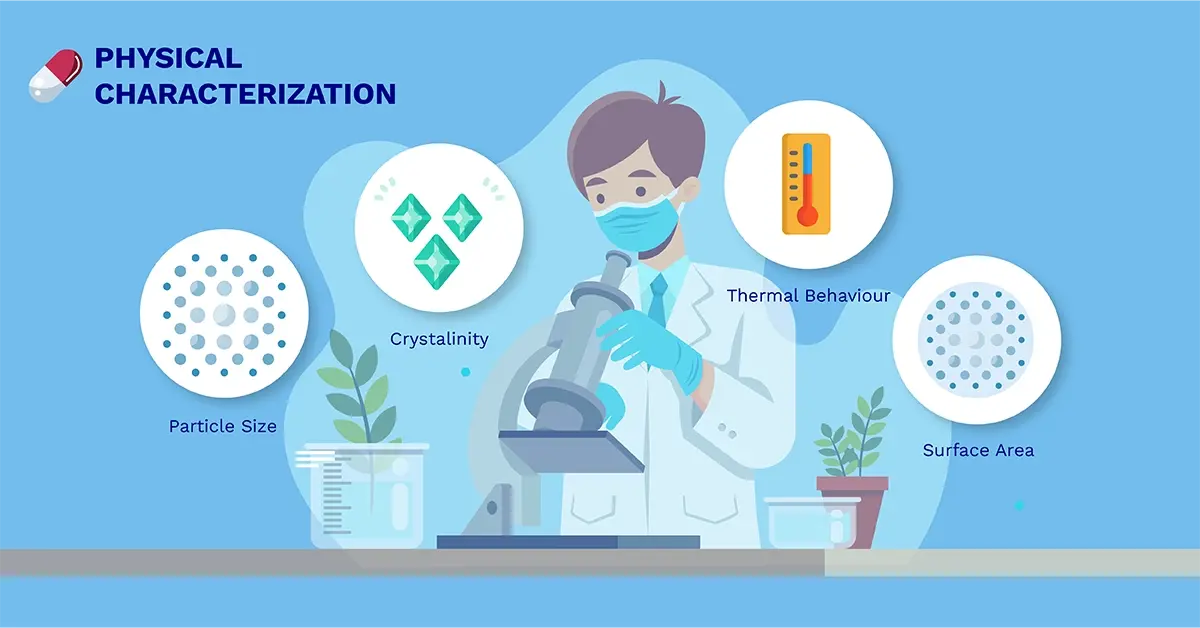
In the pharmaceutical industry, the journey from molecule to medicine is shaped not only by chemical composition but also by the physical properties of materials. Attributes such as particle size, crystallinity, thermal behavior, and surface area play a pivotal role in determining how a drug performs, how stable it remains over time, and how efficiently it can be manufactured.
- Particle size affects dissolution rate, bioavailability, and uniformity in dosage forms.
- Crystallinity and polymorphism influence solubility, stability, and therapeutic efficacy. \
- Thermal behavior reveals compatibility with excipients and helps predict degradation pathways.
- Surface area and porosity impact adsorption, flowability, and release kinetics—especially in inhalables and controlled-release formulations.
These parameters are not just scientific curiosities, they are critical quality attributes (CQAs) that must be understood, controlled, and documented to meet regulatory expectations
Instrumentation That Powers Precision
Our physical characterization laboratory is equipped with a suite of advanced analytical instruments that enable comprehensive material characterization. Each tool is selected for its ability to deliver high-resolution, reproducible data across a range of pharmaceutical applications.
Instrument Capabilities Overview
|
Instrument |
Technique |
Key Capabilities |
Pharmaceutical Applications |
Regulatory Relevance |
|
Bruker D8 Advance PXRD |
Powder X-Ray Diffraction |
- Phase identification |
- Solid-state form selection |
- ICH Q6A: Specification setting |
|
Malvern Mastersizer 3000+ |
Laser Diffraction PSD |
- Particle size distribution (0.01–3500 µm) |
- Dissolution rate prediction |
- ICH Q8: QbD framework |
|
Discovery SDT 650 DSC-TGA |
Simultaneous Thermal Analysis |
- Melting point, Tg, decomposition |
- Excipient screening |
- ICH Q1A(R2): Stability testing |
|
Micromeritics Gemini VII BET |
Surface Area & Porosity |
- BET surface area |
- Inhalables and porous excipients |
- ICH Q3D: Impurity risk via surface area |
These instruments form the backbone of our physical characterization services, enabling data-driven decisions in formulation development, scale-up, and regulatory submissions
Regulatory Momentum: Why Characterization Matters More Than Ever
The pharmaceutical industry is experiencing a paradigm shift where physical characterization is no longer optional, it’s foundational to regulatory compliance, product quality, and global market access. This momentum is driven by evolving guidelines, stricter inspections, and a growing emphasis on data integrity and material traceability.
Harmonization of Global Standards
In an increasingly inter-connected pharmaceutical landscape, regulatory agencies across the globe are moving toward harmonized standards that emphasize consistency, transparency, and scientific rigor. This convergence is reshaping how physical characterization is approached, documented, and audited. Historically, pharmaceutical companies faced fragmented regulatory expectations across different markets. Today, initiatives like the International Council for Harmonisation (ICH) and WHO Prequalification Programme are streamlining requirements, making it essential for manufacturers to adopt universally accepted analytical practices.
Regulatory agencies worldwide are aligning their expectations around material science and analytical rigor:
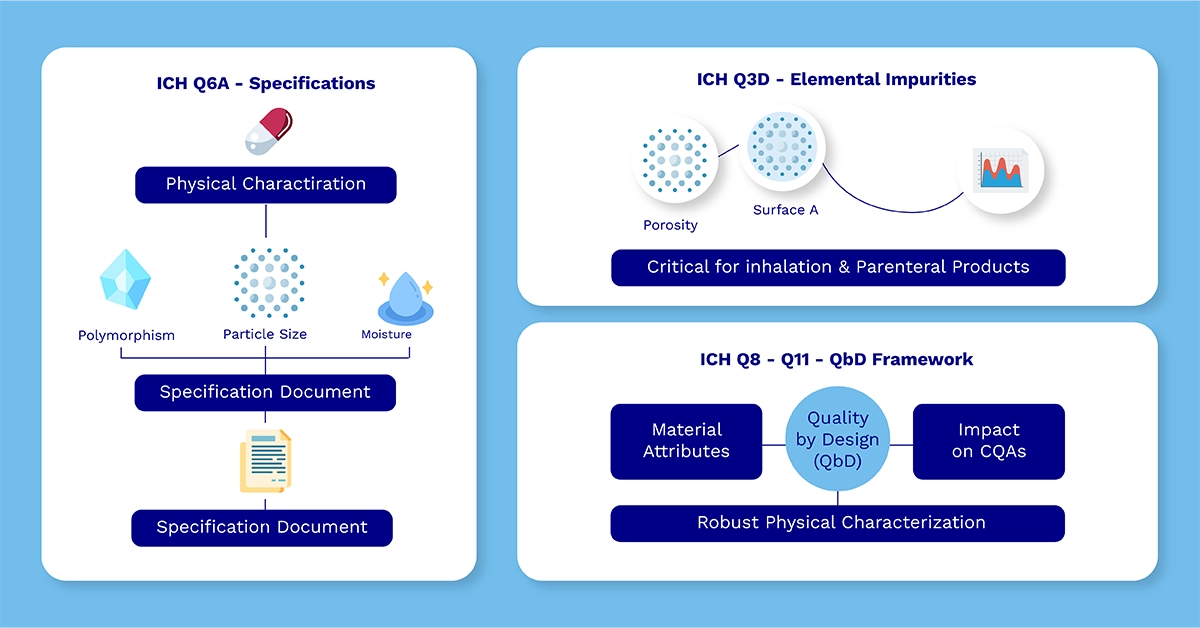
- ICH Q6A (Specifications: Test Procedures and Acceptance Criteria): Requires detailed physical characterization data—such as polymorphism, particle size, and moisture content—as part of the specification setting for new drug substances and products.
- ICH Q3D (Elemental Impurities): Surface area and porosity data from BET analysis are increasingly used to assess the risk of elemental impurities, especially in inhalation and parenteral products.
- ICH Q8–Q11 (QbD Framework): Emphasizes understanding material attributes and their impact on Critical Quality Attributes (CQAs), reinforcing the need for robust physical characterization during development and lifecycle management.
India’s Revised Schedule M (2025): A Game-Changer
- India’s Ministry of Health has introduced revised Schedule M GMP norms, effective January 1, 2025, which bring Indian pharmaceutical manufacturing closer to WHO-GMP and EU-GMP standards.
Raising the Bar: Regulatory Essentials for Physical Characterization in 2025
- Mandatory equipment validation: Instruments like XRD, PSD analyzers, DSC-TGA, and BET must be qualified and calibrated regularly.
- Data integrity (ALCOA+): All analytical data must be attributable, legible, contemporaneous, original, and accurate—plus complete, consistent, enduring, and available.
- Material traceability: Batch-to-batch consistency in physical attributes (e.g., polymorphs, particle size) must be documented and justified.
- Inspection readiness: Regulatory audits now scrutinize physical characterization reports, method validation, and analyst training records.
These changes are particularly critical for companies exporting to regulated markets or seeking WHO prequalification
CTLs with validated methods and regulatory-aligned infrastructure are essential partners in helping pharma companies stay ahead of these evolving expectations.
Partnering for Compliance and Innovation
In this new regulatory era, physical characterization is not just about compliance—it’s about building quality into every molecule. Shiva Analyticals (India) Private Limited is your strategic partner in navigating this complex terrain with confidence and scientific precision.
Our physical characterization services are designed to support pharmaceutical innovation while ensuring regulatory compliance. We offer:
- Rapid turnaround for high-throughput screening and batch release
- Expert interpretation of complex data sets for formulation and stability decisions
- Regulatory-ready documentation for global submissions
Whether you're developing a new molecule, reformulating an existing product, or preparing for inspection, we provide scientific depth and regulatory foresight to help you succeed.
About Shiva Analyticals
Shiva Analyticals is a leading testing laboratory in India, offering precise analytical services across industries such as pharmaceuticals, food, agriculture, and petroleum. Specializing in regulatory compliance and safety, Shiva uses state-of-the-art facilities and cGMP-compliant practices to deliver reliable, tailored solutions that help businesses ensure product quality and meet industry standards.