





Discover why rare earth elements are strategically important, how they are extracted and processed, and how advanced analytical techniques such as ICP-MS, ICP-OES, XRD and SEM-EDS support mineral exploration, resource evaluation and the rare earth supply chain.
The term"rare earth" is actually a misnomer. REEs are generally not rare in terms of crustal abundance. Their "rarity" arises because they are seldom concentrated into economically mineable deposits and are difficult and expensive to separate from one another due to their very similar chemical properties.
Elements such as cerium, lanthanum, and neodymium are more abundant than several commonly used metals. They are called "rare" mainly because economically exploitable deposits are uncommon and separation is difficult.
Relative Abundance REEs and commonly used metals:
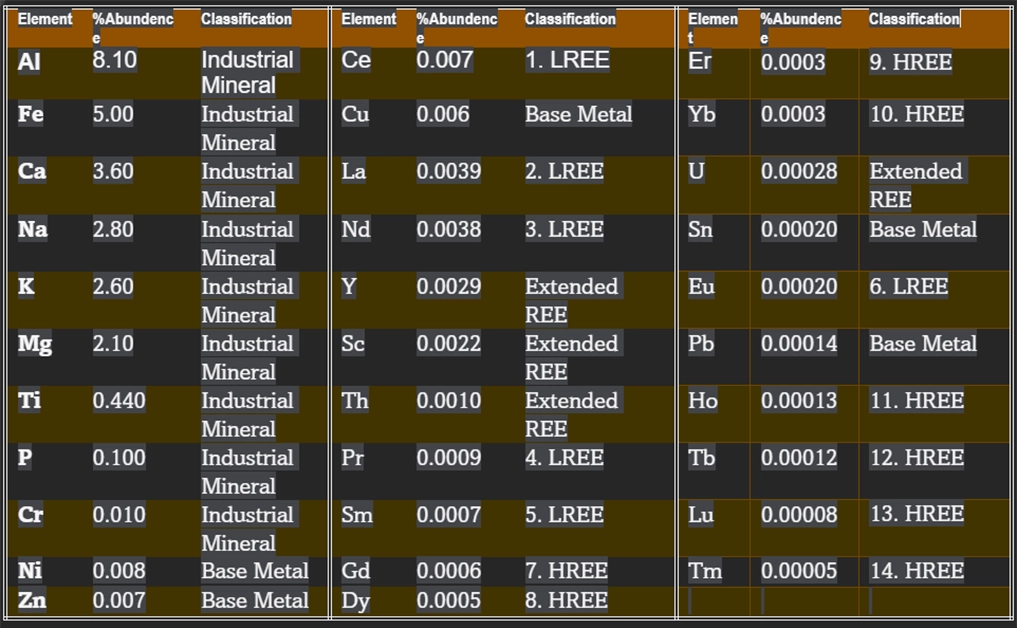
REE Classification (General)
6 numbers of LREE (Light Rare Earth Elements)
La, Ce, Pr, Nd, Sm, Eu
7 numbers of HREE (Heavy Rare Earth Elements)
Gd, Tb, Dy, Ho, Er, Tm, Yb, Lu
2 numbers of Extended REEs (part of the 3rd Group Elements along with REEs with similar properties)
Sc, Y
2 Actinides commonly associated with REE deposits as Extended REEs (Actinide Elements (Ac) part of the 3rd Group Elements along with Lanthanides (La_REEs) with similar properties)
Th, U
Commercial Classification of REEs
(In REE project evaluation, geologists and investors often say)
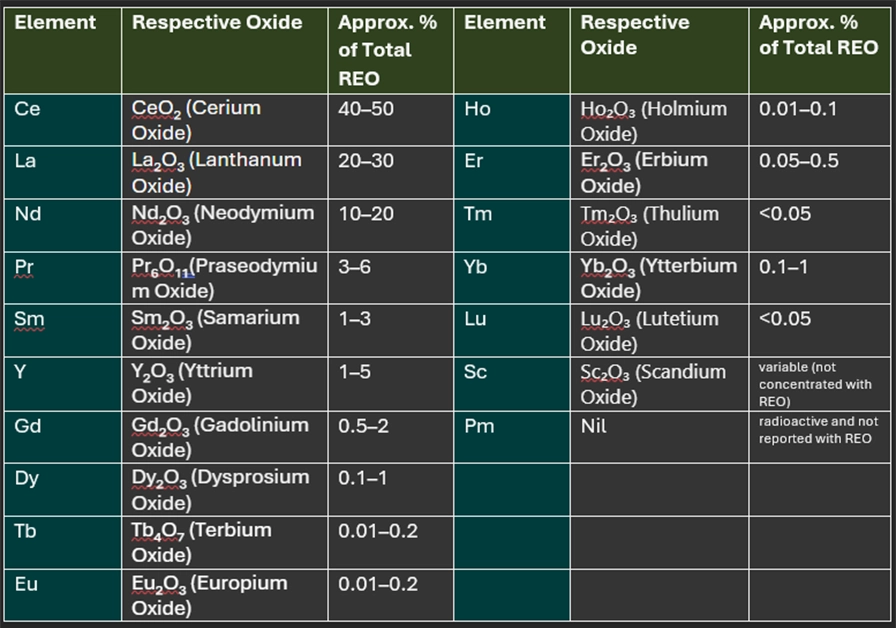
La and Ce are volume drivers
Nd-Pr and heavy REEs are value drivers
La and Ce determine how much REE material is produced
Nd, Pr, Dy, and Tb determine the profitability of the project
Periodic Classification of REEs
Dmitri Mendeleev, known as the Father of the Periodic Table, proposed the first periodic classification of elements in 1869 based on atomic weights and recurring chemical properties. The modern periodic table, later refined by Henry Moseley, arranges elements according to increasing atomic number and consists of 118 elements organized into 18 groups and 7 periods.
The lanthanides (La-Lu) and actinides (Ac-Lr), collectively known as the f-block elements, are displayed separately below the main table because of their similar chemical properties and electronic configurations.
Lanthanides (La-Lu) are a group of 15 chemically similar f-block elements located in the 6th period of the periodic table. Collectively known as the Rare Earth Elements (REEs), they are strategically important due to their widespread use in permanent magnets, electric vehicles, wind turbines, batteries, catalysts, phosphors, lasers, defence systems, and advanced electronic technologies.
Actinides (Ac-Lr) are a series of predominantly radioactive elements belonging to the 7th period of the periodic table. Unlike Rare Earth Elements, they are not extensively used in conventional industrial applications. Their principal commercial significance lies in nuclear energy, with uranium and thorium being the most important economically exploitable actinides.
Economical and Strategic Significance of REEs
LREEs mainly used in Catalysts, Magnets, Batteries & Glass
HREEs mainly used in High-performance magnets, Fiber optics, Défense systems & Medical technologies
Economically Important REEs
Magnet REEs are Neodymium (Nd), Praseodymium (Pr), Dysprosium (Dy), Terbium (Tb) & Samarium (Sm) for permanent magnets used in EV motors, wind turbines, aerospace, and defense applications.
Battery and Catalyst REEs are Lanthanum (La) & Cerium (Ce) for rechargeable batteries, petroleum refining catalysts, automotive catalysts, and glass polishing.
Optics and Electronics REEs are Europium (Eu), Yttrium (Y), Erbium (Er), Ytterbium (Yb), Holmium (Ho) & Thulium (Tm) for phosphors, LEDs, lasers, fiber optics, displays, and optical communications.
Medical REEs are Gadolinium (Gd) & Lutetium (Lu) for MRI contrast agents, cancer therapy, medical imaging, and nuclear medicine.
Advanced Materials and Alloys REEs are Scandium (Sc), Lanthanum (La) & Cerium (Ce) for high-strength aerospace alloys, fuel cells, specialty glasses, and advanced ceramics.
Strategic and Defense REEs are Dysprosium (Dy), Terbium (Tb), Holmium (Ho), Erbium (Er), Ytterbium (Yb) & Lutetium (Lu) for defense electronics, sensors, guidance systems, lasers, and high-temperature magnets.
Research and Specialty REEs are Promethium (Pm) for nuclear batteries, luminous devices, and scientific research applications.
Associated Nuclear Elements are Thorium (Th) & Uranium (U), which commonly occur with REE deposits and are important for nuclear energy and strategic applications.
List of 6 elements drive global REE market today
Neodymium (Nd): Electric vehicle (EV) motors, wind turbine generators, and high-strength permanent magnets (NdFeB magnets).
Praseodymium (Pr): Permanent magnets, aerospace alloys, specialty glasses, and high-strength metal alloys.
Dysprosium (Dy): High-temperature permanent magnets used in electric vehicles, wind turbines, aerospace, and defense applications.
Terbium (Tb): Green phosphors for display screens and lighting, magnetostrictive materials, and high-performance permanent magnets.
Cerium (Ce): Automotive catalysts, glass polishing powders, metallurgy additives, fuel additives, and UV-resistant glass.
Lanthanum (La): Rechargeable NiMH batteries, petroleum refining catalysts, optical glass, camera lenses, and specialty ceramics.
How Are Rare Earth Elements (REEs) Extracted?
The extraction of REEs is significantly more complex than that of most common metals because the REEs occur together in minerals and possess very similar chemical properties. The overall process involves exploration → mining → beneficiation → chemical extraction → separation → purification → oxide/metal production.
The real value in the REE industry lies not in mining alone but in the downstream chemical separation and purification of individual REEs. Mining may produce a mixed REE concentrate, but sophisticated hydrometallurgical processing and solvent extraction are required to produce individual products such as Nd₂O₃, Pr₆O₁₁, Dy₂O₃, Tb₄O₇, CeO₂, and La₂O₃ for commercial applications. This separation capability is the technological backbone of the global rare earth supply chain.
REE Analytical Methodologies: Quantitative and Mineralogical Characterization
The characterization and analysis of Rare Earth Elements (REEs) require a combination of chemical, mineralogical, and microscopic techniques, as no single method can provide complete information on elemental concentrations, mineral associations, occurrence modes, and deportment. The commonly employed methodologies include:
X-Ray Fluorescence (XRF): Used for rapid, non-destructive screening and estimation of major, minor, and selected REE concentrations. Pressed-pellet XRF is generally suitable for preliminary assessment and relative abundance studies but is not recommended for final certification or commercial settlement of REE concentrates. In general, only REE concentrations exceedingly approximately 0.05% can be reliably identified and assessed through this approach. The technique is therefore suitable for quick evaluation and process monitoring but should not be considered a definitive analytical method for laboratory certification. For commercial reporting, resource evaluation, and final certification, more accurate techniques such as ICP-OES or ICP-MS following appropriate sample digestion and quality control protocols are recommended.
Inductively Coupled Plasma Optical Emission Spectrometry (ICP-OES): A quantitative analytical technique capable of determining individual REE concentrations following appropriate sample dissolution. It is widely used for medium to high concentration REE analysis and is particularly suitable for rare earth ores, concentrates, process products, and metallurgical samples. Accurate determination of individual REEs can be achieved after complete sample decomposition using suitable fusion techniques, such as lithium borate fusion or sodium peroxide fusion, followed by solution preparation. When calibrated against traceable Certified Reference Materials (CRMs) and supported by appropriate quality control measures, ICP-OES provides reliable and commercially acceptable analytical data for REE concentrates and ore-grade materials. However, due to its comparatively higher detection limits, limited sensitivity for many heavy rare earth elements (HREEs), and susceptibility to spectral interferences arising from the complex emission spectra of REEs and matrix elements, ICP-OES is generally not recommended as the primary analytical technique for greenfield exploration projects, geochemical exploration programs, resource delineation, or Mineral Resource and Ore Reserve estimation and certification studies, where accurate determination of low-level REE concentrations is critical. For such applications, ICP-MS is the preferred technique because of its superior sensitivity, lower detection limits, wider dynamic range, and ability to accurately quantify trace and ultra-trace concentrations of individual REEs required for exploration, resource evaluation, and compliance with international reporting standards.
Inductively Coupled Plasma Mass Spectrometry (ICP-MS): ICP-MS is the preferred analytical technique for the accurate determination of individual Rare Earth Elements (REEs) at trace to medium concentration levels. The technique offers exceptional sensitivity, ultra-low detection limits, a wide dynamic range, and the capability to simultaneously determine all REEs in a single analysis. ICP-MS is generally regarded as the industry-standard methodology for REE resource evaluation, geochemical exploration, resource estimation, and final certification. ICP-MS is particularly essential for greenfield exploration projects, where REE concentrations commonly occur at trace to minor levels in soils, stream sediments, rocks, and drill-core samples. Alternative techniques such as XRF and, in many cases, ICP-OES may not provide the required sensitivity at these low concentration levels and can be affected by spectral overlaps, matrix effects, and elemental interferences, potentially leading to false positives or false negatives. Following complete sample dissolution using appropriate digestion or fusion procedures and calibration against traceable certified reference materials (CRMs), ICP-MS provides reliable and accurate quantification of REEs. Consequently, ICP-MS is the preferred technique for geochemical exploration, anomaly delineation, resource identification, deposit evaluation, and certification of REE-bearing materials throughout the exploration and resource development cycle.
X-Ray Diffraction (XRD): X-Ray Diffraction (XRD): XRD is a mineralogical characterization technique used to identify REE-bearing minerals and associated gangue minerals in ores, concentrates, and geological samples. The technique is valuable for mineral identification, ore characterization, beneficiation studies, and understanding the mineralogical deportment of rare earth elements. XRD is particularly useful during the advanced stages of resource evaluation where REE-bearing minerals such as monazite, bastnäsite, xenotime, allanite, and other associated phases have already been identified.
However, XRD is not a direct chemical analytical technique and is therefore not suitable for determining commercial grades or certifying REE concentrations. The detection and quantification of REE-bearing minerals become increasingly difficult when their concentrations are low, with reliable identification generally requiring mineral concentrations in the range of approximately 0.5-1% or higher, depending on mineral crystallinity, sample preparation, and matrix composition. Consequently, XRD is not considered a suitable tool for initial greenfield geochemical exploration projects, where REEs are typically present at trace levels. Instead, XRD is most effectively applied to known mineralized resources, concentrates, and advanced-stage exploration samples to confirm mineralogy, identify REE host minerals, and support process mineralogical investigations. For initial geochemical exploration, resource delineation, and grade estimation, analytical techniques such as ICP-MS are preferred due to their superior sensitivity and ability to quantify individual REEs at trace concentrations.
Scanning Electron Microscopy with Energy Dispersive Spectroscopy (SEM-EDS): SEM-EDS is a powerful microanalytical technique used for the characterization of REE-bearing minerals, their mode of occurrence, grain size distribution, mineral associations, and textural relationships within ores, concentrates, and tailings. The Scanning Electron Microscope (SEM) provides high-resolution imaging of mineral particles, while the attached Energy Dispersive Spectroscopy (EDS) system enables elemental identification and semi-quantitative chemical analysis at specific points, along grain boundaries, or across mineral phases.
SEM-EDS is particularly valuable in REE exploration and mineral processing studies because it allows direct identification of REE host minerals such as monazite, bastnäsite, xenotime, allanite, synchysite, parisite, and other rare earth-bearing phases. The technique can distinguish REE minerals from associated gangue minerals and provides insights into mineral liberation characteristics, intergrowth relationships, inclusions, and alteration features that influence beneficiation and extraction performance.
SEM-EDS also assists in determining whether REEs occur as discrete mineral phases, lattice substitutions within other minerals, coatings, or fine disseminations within the host rock. Elemental mapping capabilities enable visualization of the spatial distribution of REEs and associated elements such as Th, U, Fe, Ca, P, Si, and F within individual grains and mineral assemblages.
Although SEM-EDS provides rapid mineral identification and valuable compositional information, the technique is generally considered qualitative to semi-quantitative due to limitations in detection sensitivity, spectral overlaps, matrix effects, and uncertainties associated with standardless analysis. Consequently, SEM-EDS is not suitable for accurate bulk-grade determination, resource estimation, or commercial certification of REE concentrations. Instead, it serves as an important supporting tool for exploration geology, process mineralogy, beneficiation studies, metallurgical investigations, and the selection of appropriate analytical and extraction methodologies. When combined with XRD, petrography, EPMA, ICP-OES, and ICP-MS, SEM-EDS provides critical information on the occurrence, distribution, and deportment of REE minerals throughout the exploration and development cycle.
Scanning Electron Microscopy with Electron Probe Micro-Analysis (SEM-EPMA/EPMA): SEM-EPMA is an advanced microanalytical technique that combines high-resolution imaging with highly accurate quantitative chemical analysis at the micron to sub-micron scale. The technique is extensively used in Rare Earth Element (REE) exploration, mineralogical investigations, and process mineralogy studies to determine the precise chemical composition of individual mineral grains. Unlike SEM-EDS, EPMA employs wavelength-dispersive spectrometers (WDS), which provide significantly higher spectral resolution, lower detection limits, and superior accuracy for quantitative elemental analysis.
SEM-EPMA is particularly valuable for the characterization of REE-bearing minerals such as monazite, bastnäsite, xenotime, allanite, synchysite, parisite, and other complex rare earth phases. The technique enables determination of the distribution and concentration of individual REEs within mineral lattices, identification of elemental substitutions, zoning patterns, and compositional variations within single mineral grains. It can accurately analyze associated critical elements such as Sc, Y, Th, U, Nb, Ta, Zr, Hf, P, F, Ca, Fe, and Ti, thereby providing a detailed understanding of mineral chemistry and genesis.
EPMA is also widely used for mineral deportment studies, beneficiation investigations, liberation assessment, and metallurgical process development. Elemental mapping and line-scan capabilities allow visualization of REE distribution and elemental variations across mineral grains and complex intergrowths. The technique plays a critical role in confirming REE host minerals identified by XRD and SEM-EDS and in establishing the mineralogical controls governing REE recovery.
Although SEM-EPMA provides highly reliable quantitative mineral chemistry data, it is primarily a micro-scale mineral characterization tool and not a bulk chemical analysis method. Therefore, it complements rather than replaces bulk analytical techniques such as ICP-OES and ICP-MS. When integrated with petrography, XRD, SEM-EDS, and chemical analyses, SEM-EPMA provides comprehensive information on REE occurrence, mineral associations, chemical composition, and resource potential, making it one of the most important techniques for advanced REE characterization and process mineralogy studies.
Petrography and Ore Microscopy: Petrography is a fundamental geological and mineralogical investigation technique used to study the occurrence, distribution, texture, mineral associations, and paragenesis of Rare Earth Element (REE) bearing minerals within host rocks and ore bodies. Using transmitted light, reflected light, and ore microscopy, petrographic studies provide valuable insights into the mineralogical framework of REE deposits, helping geologists understand the origin, evolution, and enrichment processes of rare earth mineralization.
Petrography plays a critical role in identifying REE host minerals such as monazite, bastnäsite, xenotime, allanite, florencite, parisite, and synchysite, as well as their associations with gangue minerals including quartz, feldspars, carbonates, micas, amphiboles, and clay minerals. Detailed petrographic examination reveals grain size, crystal habit, mineral intergrowths, alteration patterns, weathering effects, fractures, and liberation characteristics that significantly influence beneficiation and extraction efficiency.
Shiva Analyticals India Private Limited
Supporting Global Geochemical Exploration, Mining, and Trade for Over Three Decades
For more than three decades, Shiva Analyticals (India) Pvt. Ltd. has been supporting the geochemical exploration, mining, mineral processing, and commodities trade sectors across India, the Middle East, Africa, North America, and South America. The company provides comprehensive analytical and mineralogical characterization services to exploration companies, miners, traders, beneficiation plants, research organizations, and government agencies.
Shiva Analyticals operates a state-of-the-art sample preparation facility equipped with globally benchmarked sample preparation protocols and modern sample processing equipment designed to ensure representative, contamination-free, and reproducible analytical results. The laboratory infrastructure includes advanced analytical instrumentation such as Atomic Absorption Spectrometry (AAS), Inductively Coupled Plasma Optical Emission Spectrometry (ICP-OES), High-Resolution Inductively Coupled Plasma Mass Spectrometry (HR-ICP-MS), X-Ray Diffraction (XRD), and X-Ray Fluorescence Spectrometry (XRF) for the determination and characterization of a wide range of geological, mineral, environmental, and industrial materials.
In addition to its in-house capabilities, Shiva Analyticals collaborates with leading research institutions, including the Indian Institute of Science (IISc), Bengaluru, and other specialized partner laboratories, providing access to advanced mineralogical characterization techniques such as Scanning Electron Microscopy with Energy Dispersive Spectroscopy (SEM-EDS), Electron Probe Micro-Analysis (EPMA), Ore Microscopy, and Petrographic Studies. These techniques enable detailed mineralogical assessment of mineral resources, including the identification of REE-bearing minerals, mineral associations, elemental distribution, textural relationships, liberation characteristics, and beneficiation potential.
By integrating quantitative geochemical analysis with advanced mineralogical and metallurgical investigations, supported by state-of-the-art analytical infrastructure and a highly experienced team of scientists, geologists, mineralogists, and geochemists with decades of industry expertise, Shiva Analyticals delivers comprehensive and reliable solutions across the entire mining and mineral value chain.
About Shiva Analyticals
Shiva Analyticals is a leading testing laboratory in India, offering precise analytical services across industries such as pharmaceuticals, food, agriculture, and petroleum. Specializing in regulatory compliance and safety, Shiva uses state-of-the-art facilities and cGMP-compliant practices to deliver reliable, tailored solutions that help businesses ensure product quality and meet industry standards.